Kernel & Kruste
spec: live-scaler@v3.0pipeline: passed (100% oven spring)No-Panic Beginner Country Bread (70% Hydration)
Your very first real sourdough loaf without frustration: Foolproof with 70% hydration, relaxed bulk fermentation, and permitted yeast safety net.
sourdough.config.yaml# Loading recipe configuration...Peer Reviews & Bake Logs
“Pull Request approved! Controlled fermentation timing and the Dutch oven produce a reliably blistered crust every single bake.”
“Textbook ear and blistered crust. The steam trap preserves moisture perfectly before caramelization.”
Stage-by-Stage Workflow
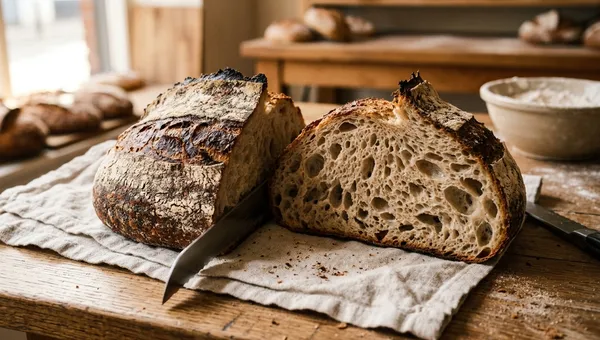
Why this recipe is your best entry point
When baking your very first sourdough loaf, you don't want to wrestle with an 85% hydration sludge that sticks like bitumen to your hands. You want a dough that:
- Holds its shape: At 70% hydration, dough shapes effortlessly and builds great surface tension.
- Rises reliably: Even if your starter is only 2 weeks old.
- Bakes in a Dutch oven: Trapping moisture for explosive oven spring without costly professional oven steaming equipment.
The Golden Rule: Yeast is Zero Shame!
In internet forums, purists act like sourdough combined with commercial yeast is a sin. That is nonsense.
If your starter is young (under 4 weeks old), its lactobacilli are already creating delicious tang, but wild yeast counts can be sluggish. A tiny pea-sized crumb of fresh yeast (0.5g–1g) ensures your bread rises proudly, while your sourdough contributes 99% of complex flavor and keeping qualities.
Think of yeast as a try / catch block: it catches runtime errors and saves your Sunday breakfast!
The Formula (Baker's Percentages)
- Flour (100%): 450g Bread Flour (Type 550) + 50g Whole Wheat or Rye
- Water (70%): 350g lukewarm (~26°C / 78°F)
- Sourdough Starter (20%): 100g active starter (doubled)
- Salt (2%): 10g fine sea salt
- Safety Net (optional): 1g fresh yeast
Step-by-Step Instructions
Step 1: Autolyse (30 Minutes)
Coarsely mix flour and 330g water until no dry flour spots remain. Cover and rest 30 minutes. The gluten network builds automatically without kneading.
Step 2: Inoculate Starter & Salt (10 Minutes)
Add active starter, salt, remaining 20g water, and optional yeast. Knead and fold with wet hands until smooth and supple.
Step 3: Bulk Fermentation & Coil Folds (3–4 Hours at 22–24°C)
Place in an oiled bowl. Perform 3–4 gentle coil folds every 30 minutes during the first 2 hours. Rest until dough expands ~50% in volume with visible bubbles.
Step 4: Preshaping & Banneton (15 Minutes)
Turn onto a lightly floured surface. Pull edges to center and round into a taut boule. Place seam-up into a banneton dusted with rice flour.
Step 5: Cold Retardation (12–16 Hours Overnight)
Slip banneton into a bag or cover with shower cap and chill in the fridge at 4–6°C overnight.
Step 6: Dutch Oven Bake (45 Minutes)
Preheat Dutch oven at 230°C for 45 minutes. Turn cold loaf onto parchment paper, score 1cm deep with a razor blade, and lower into pot.
- 20 minutes with lid on at 230°C (steam phase).
- Remove lid and bake 25 minutes at 210°C until dark mahogany and blistered.
- Cool on wire rack for at least 2 hours before slicing!